Yesterday I slipped up and said “AI art,” despite promising myself I’d never apply the word art to the coagulated slop that makes up an estimated 70% of Instagram content at this point. Ever since that AI-generated image won a State Fair art contest in 2022, it has become all too easy to fall into fisticuffs over these images. Some consider them art, some consider them a time-saving device, some consider them good marketing, and others waste hours writing drag pieces on the up and coming wave. This blog post is the latter.
I played with some AI generated imagery in the beginning, in 2022 before I knew it was evil. In seconds, the ideas in my head were immediately realized on a screen without the need for me to engage with materials. It was fun, it was exciting—and then I got bored really fast, because that seems to be the nature of quick dopamine hits. As the years have gone by and Will Smith gets better at eating spaghetti, the discussions around AI are becoming increasingly complicated. One question that gets raised is, does the creator of the image own the image? Opinions vary. “AI imagery is theft,” seems to be a common refrain, although the legal reality of art theft is a lot more complicated, as Kyle Chayka explains in a great article on copyright law and AI-generated works.
But what’s the big deal with it? It’s just fun, right? What makes art, art? That’s a huge question with currently no real consensus. I have my own opinions, but instead of stating them outright, I’d like to discuss some common features carried by much art.
Materials, Time, Meaning
Materials. When talking about AI-generated works, the word “work” is a stretch, since the image is produced with close to zero effort put in by the user. No pens, brushes, scissors or glue are used. Engaging with materials is important here, because an artist is intimately familiar with their materials. Artists take their implements on the road or set up studios with their paints and brushes and pens and canvases in one place so they can access them on the daily. Sooner or later you end up with a favorite tool, like the Platinum Preppy .5 fountain pens I’ve been using for years. We get attached to our tools, build relationships with them, get to know them, and then they become an iconic feature of our work. There’s a joy in the materials that’s missing in AI-generated images.
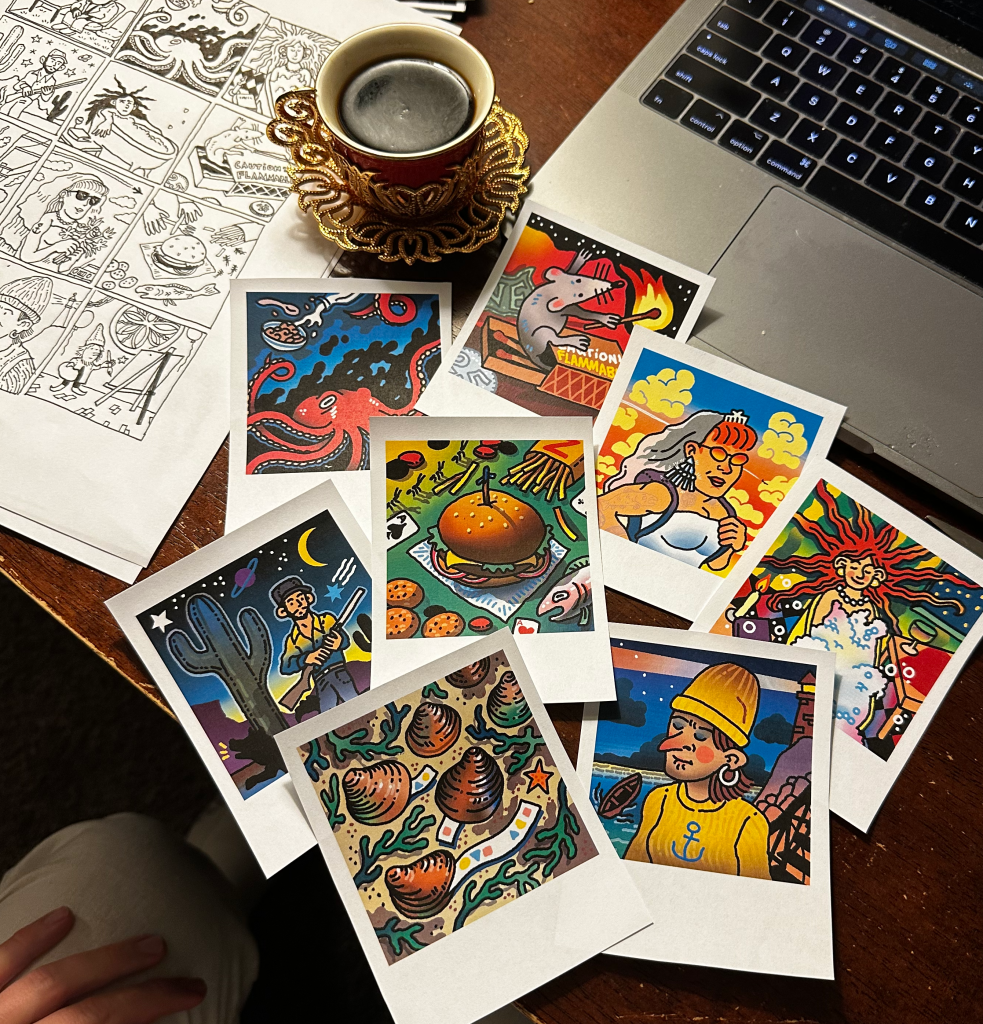
Time. Art is the process of time. You draft your ideas, sketch out your forms, draw in the lines, color the spaces in between. You spin the clay on the wheel, get charcoal under your fingernails, and chisel out forms from marble. I can safely claim that this has been the process of art for millennia.
Meaning. Art is a medium for meaning. There’s a purpose in the composition and the lighting and the tension and the color palette and choice of materials. Whether intentional or unintentional, art delivers a message. After his partner wasted away from AIDS, Félix González-Torres piled wrapped candies in a corner of a museum, inviting patrons to help themselves, and called it Portrait of Ross in L.A. As visitors took away piece by piece of candy, the 175-pound work of art, like Ross, slowly disappeared. I once had the pleasure of touring Maine artist (and dear cousin) Karen Gelardi’s studio. We were looking at some paintings she had done at Surf Point, and she told me, “The whole time I was making these, I was thinking about ghosts.” You can see spaces in the images where a person should be, but isn’t.
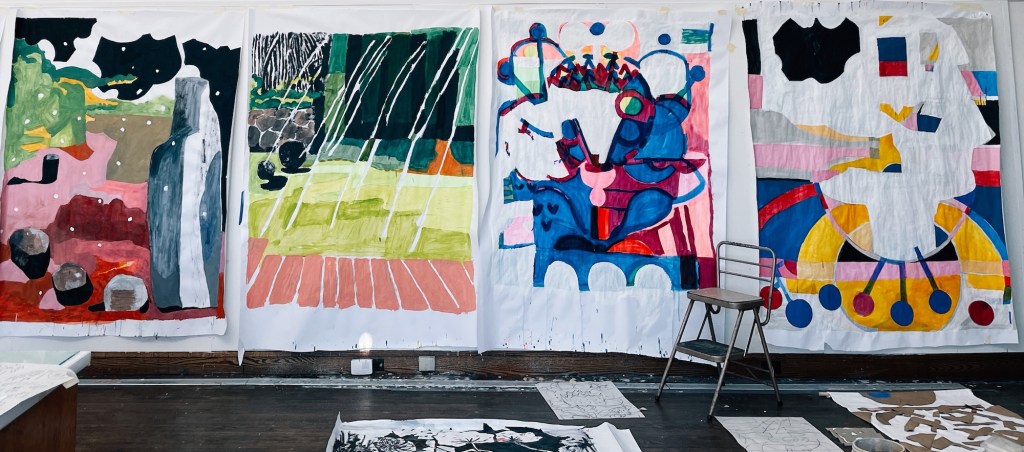
It struck me that this is what artists do: we hold an idea in our head, and then through great effort and toil, we mold that idea into an image. Some days it’s easier than that, and some days it’s torture.
Materials, time, and meaning. Without doing study sketches, sitting outside and pondering medium and message, and looping in elements from the artist’s own life, what exactly do we call the thing created from boiling together all art ever made? An amalgamation? A broad summation? A generalization? Intellectual property rights lawyer Kate Downing put it best in the linked article above: “Mathematically speaking, the work comes from everything.”
The Case for AI-Generated Images
Defenders of AI-as-art usually make a couple main arguments: it makes creativity accessible, and it’s cheap or free. I’ll address these one by one.
Making creativity reachable for everyone. Supporters of AI-gen images claim that creativity is an inherent privilege, and that the world can be divided into creative people and uncreative people. For true equity, this gap must be bridged, and AI does that bridging. Interestingly, I have yet to see this argument approached from a standpoint of disability and accessibility—rather, the focus falls on whether or not someone is “creative.” The creative people I know don’t draw in their sleep. They work like crazy, and often they drag their feet through days, weeks, or even years of feeling uncreative. That’s part of being a creative person. Dividing the world into creative and uncreative people diminishes the amount of work that goes into making art.
My issue with the “it helps uncreative people” argument is that while it does make a quasi-creativity reachable, it does not ultimately bridge the gap. The user can’t create those images without AI’s help. In a locked room with a pen and paper, the images will not materialize. It’s like if I claimed to be bilingual, then showed up on the job with an electronic translator. Sure, AI helps you visualize what’s in your head, but so would an artist. The barrier here is that you’d have to pay an artist, which brings us to our second point.
It’s cheap/free. Yes, it costs zero dollars to generate an image with ChatGPT. And you get what you pay for. Why is it, I’ve wondered lately, that the right loves AI-generated images? How is this machine-made garbage the darling of the Epstein class? For a group of people so dead-set against progress and all about returning to the old ways, why have they welcomed this bullshit pudding with open arms? Because AI image generators can’t say no.
Artists have always been subversive, always caused trouble, always made people angry. Art has the power to evoke feelings, to create drama, to make people think, and to discuss ideas. Conversely, AI-generated imagery was born to please. Quite literally. Talk to Chat GPT and you’ll find yourself locked in conversation with a codependent sycophant affirming everything you say. This pandering could be the reason an estimated an estimated 30% of Americans have had a romantic relationship with an AI. It de-escalates with customer service language rather than start drama. And so when you ask it to make an image, it will do its best to please you.
Though AI-generated images are getting clearer, more lifelike, and more seamless, we’re lucky to still be in the age where they’re uncanny enough to spot. I can sniff out an AI image most of the time, and AI writing is similarly detectable. They both possess a soulless need to please.
The Lack of a Soul
A painter I know, Richard Mauro, once told me as we toured his studio in France, “People often ask me if I enjoy painting. I don’t. It’s not one bit of fun.” The quote has stuck with me for ten years. I love being an artist, but the process is work. We stay awake deep into the night struggling over a plot twist, light our cellophane on fire in desperation, and spend a decade painting a pair of lips. All of this pain channels our soul out of our bodies, through our implements, and into art. I tend to stop creating when I’m truly happy. A hypothetical machine that would make art effortless, fun, free, and easy, is a machine that doesn’t make art. Like an automaton, AI-generated images have a spooky realness to them, but they’re missing that special something, the struggle and the effort and the meaning and the time. In a poetic sense, they lack a soul.
So I’ll continue referring to slop as AI-generated images. I’ll save the word “art” for the stuff made by the women and men who stare at grape leaves trying to figure out the light, read for hours long after sundown, and mix tubes of gouache to get that perfect yellow.
I’m saving the word “art” for stuff made by people.


 zudlow
Leave a comment