The only way I can describe this week so far is breakneck. I feel like I’ve seen more of California in a week than some Californians do in their lives. On Sunday we went to Big Trees, where we saw towering California redwoods. On Wednesday, we drove to Lake Tahoe and hiked a mountain. And on Thursday, we casually drove to Yosemite and climbed a million stone stairs to see Vernal Falls. On Friday we collapsed, and on Saturday we mustered up some energy to drive to San Francisco.

Chinatown and Union Square are joined (or separated?) by the Stockton Street Tunnel. On the south side of the tunnel is uptown, with glittering buildings boasting well-known brand names like Apple, Nike, Cartier and Dior. The tunnel acts like a portal to another hemisphere, with the other end leading to Chinatown, crowded with mask-wearing people speaking Cantonese. Shop windows are plastered with big Chinese characters, and vegetables in cardboard boxes are labeled with brush script. The San Francisco Chinatown is said to be the most densely-populated area West of Manhattan, and that’s a statistic I’m not about to debate. Place is jam-packed.
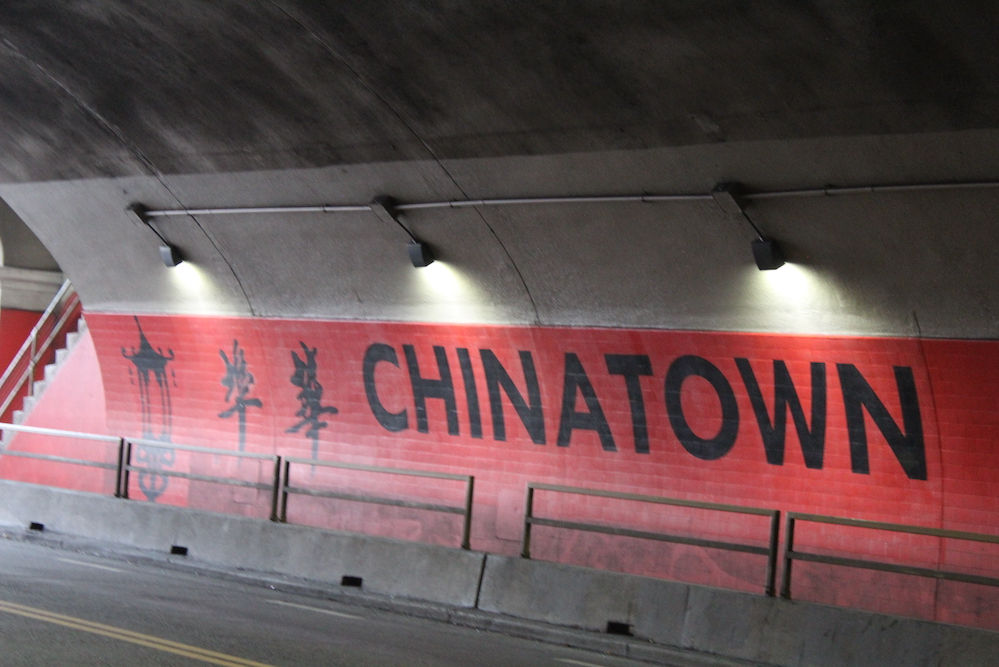

The first Chinatown I visited since getting back to America was in Sacramento, and it was both jarring and disappointing. Quiet wasn’t the word for it—it felt like a tomb. I saw literally four people walking or sitting in the square, with long empty streets and little tile-roofed buildings that seemed to be either locked up or empty. The only open restaurant was Thai.
So you can imagine the shock of entering the San Francisco Chinatown just a week later. Absolutely jam-packed and jittering with activity, my senses tingled when I heard neighbors calling to each other in Cantonese, smelled dried herbs and spices wafting from open shop doors, and saw franchises that I thought only existed in Asia.
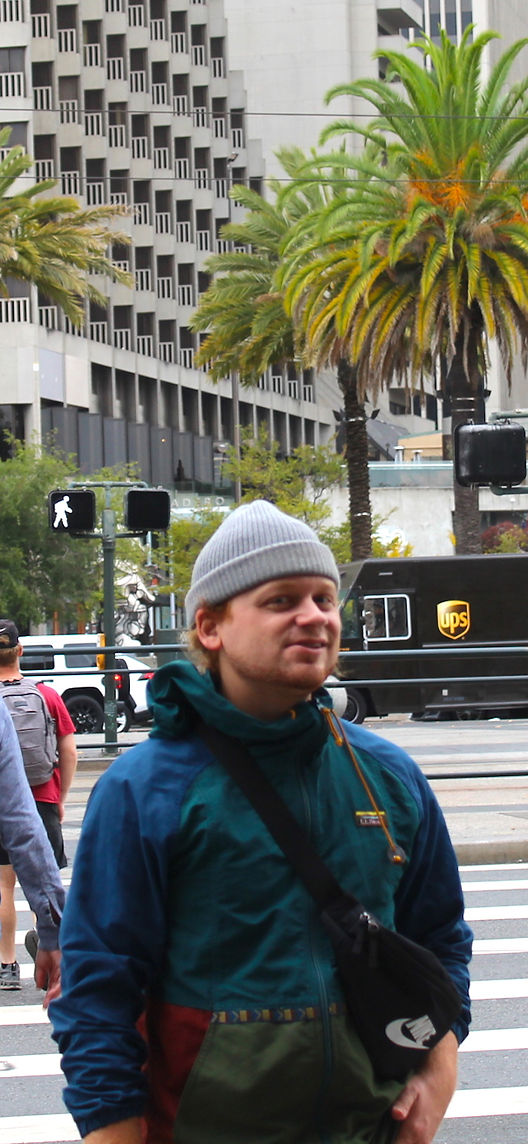
Let’s talk real quick about how to carry yourself in a city—because I wish I knew how. When I first got into San Francisco, I had no idea how to act. Negotiating space in a large city is really about body language and movement, which is different from culture to culture, and I didn’t know how to juggle any of that here in America. How wide a berth do you give people? Do you make eye contact? How fast is too frantic, and how slow is suspicious? I didn’t realize until stepping into the big city that these are all behaviors you subconsciously learn over your lifetime, and you learn them differently depending on where you spend your time. The past four years I lived in Taipei, and this summer I spent four months in Seward, Alaska, a town of three thousand people. If I ever knew the protocol for moving around in a large American city, I’ve long forgotten it. Having spent almost no time at all in large metropolitan areas in the states, I wouldn’t describe myself as a street smart person.
As soon as I got to Chinatown though, I felt a change in the way I walked, rushing past Aunties, lining up to enter bakeries, and handling cash with two hands. Maybe I am street smart, but definitely only in Mandarin.
And the food? The food in Chinatown was easily the funnest part of San Francisco. In the Alaskan small town where I spent my summer, the only Chinese food was at an overpriced restaurant run by a Korean family. So for an ex-expat, walking through Chinatown was like being in a candy shop with a wallet full of fifties. Steamer tins and bakery windows were filled with goodies that for the past few months I’d only daydreamed about while scrolling food photos on Instagram. And after a summer of pinching pennies in the sixth-most expensive state in the union, everything felt like it cost cents on the dollar.
The first thing I did was line up at a 30-minute long queue in front of a restaurant called Good Mong Kok Bakery. It has good reviews on Google, but even if it didn’t, a long line is always a sign that a shop is worth rolling up to.

The line moved up. I asked Bobbi (you may remember her from our trip to Utqiaġvik) to hold my place, and slipped into a medicine shop where a sign said masks were going at $9.99 for a box of 50. That was a bargain that I haven’t seen since Taiwan. I zipped into the store, goods piled high on both sides, and asked the clerk if she had any masks that were made in Taiwan. She looked disappointed in the question. “No.”
The line to Good Mong Kok Bakery moved up again. Asking Bobbi to once again hold my spot in the line, I snuck into the next shop over because I saw shiny orange ducks hanging up on hooks in the storefront window. If you’ve never tried Peking duck, the sight can be nauseating, but once you try even a bite, you too may find yourself drooling at crispy duck carcasses.
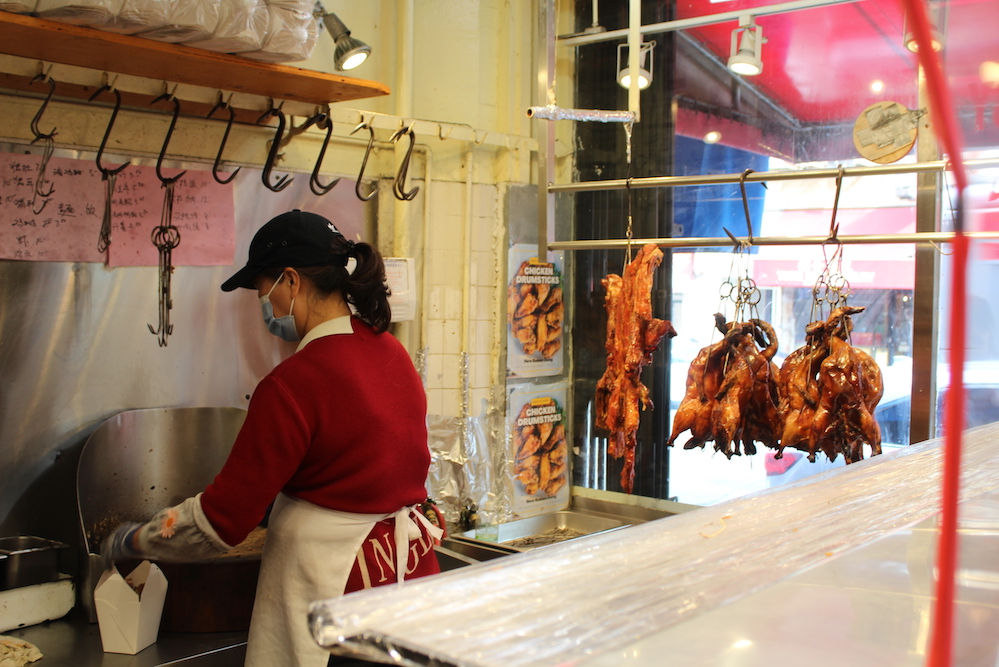
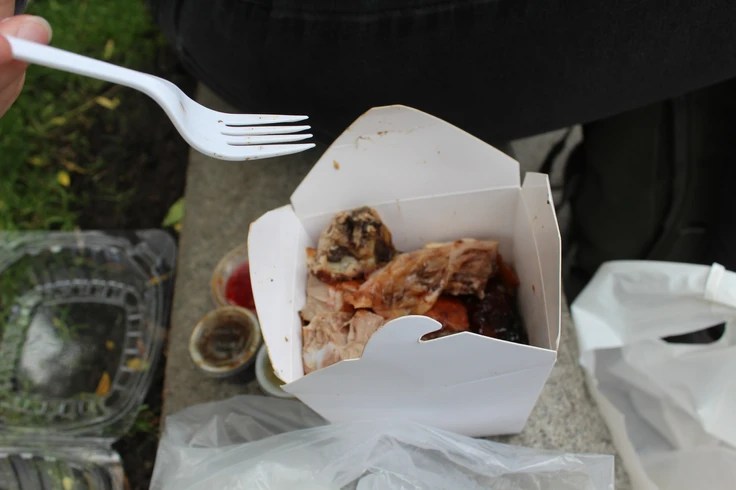
“Zhōngwén kěyǐ ma?” I asked at the counter. Is Mandarin OK? She said yes. How much, I ask, for a duck, and can I buy just half of one? When she tells me it’s $11.50 for half a duck, I decided that barring a stomach ache from too much dimsum, we’ll pick up half a duck here as well.
I guess I didn’t really need to speak Mandarin. After all, most shops seemed to be fluent in English. But I’ve never bought Peking duck in America, only Taiwan and China, and I only learned how to discuss the transaction in Mandarin. It just made more sense.
The line to Good Mong Kok Bakery moved up again, and me and Bobbi finally found ourselves inside the tiny shop.
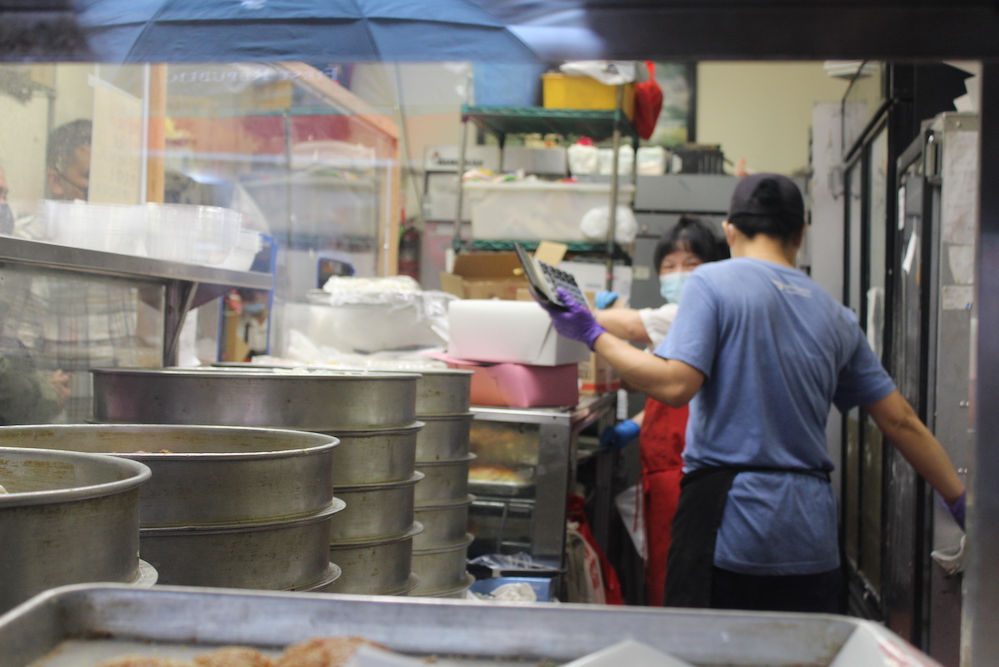
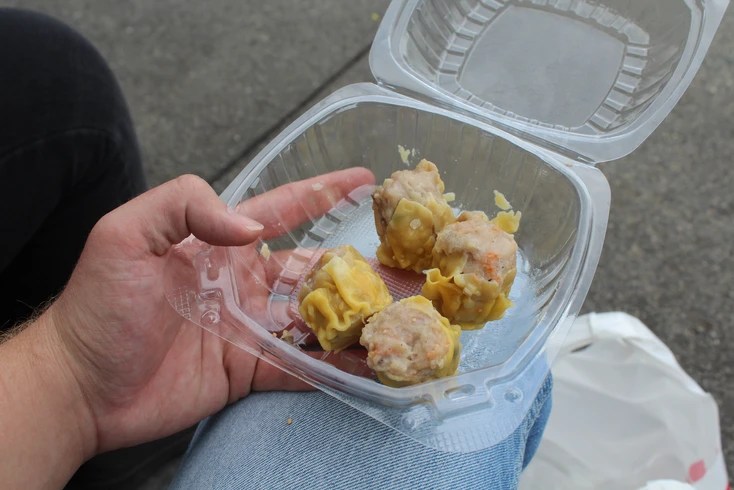
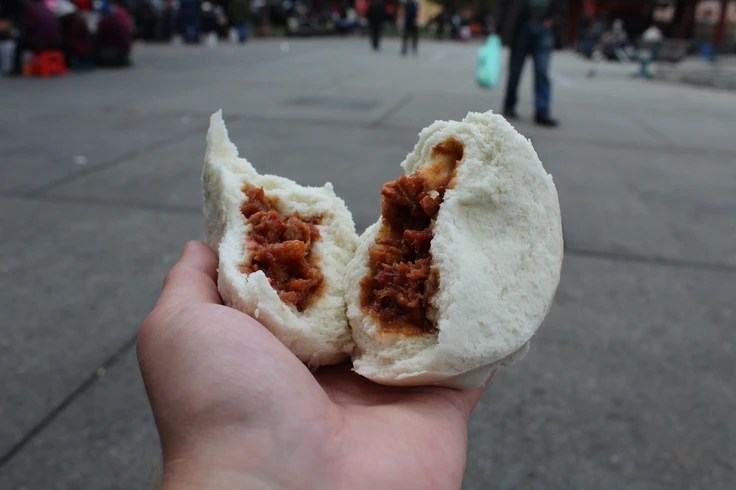
The bakery has barely enough room for a single row of people to stand at the counter and point. I asked again, “Is Mandarin alright?” in Chinese, but this time was met with a look of confusion, so I switched to English. “OK. Fried green onion pancake, pineapple cake—no pineapple cake? OK, barbecue pork buns, a red bean bun, pork and vegetable buns, shu mai.” We left the tiny shop carrying a $9 bag of dimsum goodies. Jumping back into the duck shop, we acquired our half duck, then headed to a place where we could eat our Chinese food in peace.
The destination turned out to be a little park where a billion old folks sat playing card games while someone sang traditional songs accompanied by a live band. Pigeons tentatively approached our feet while we worked through our food.
It was so nice to have some familiar flavors and textures again. I miss Asia daily.

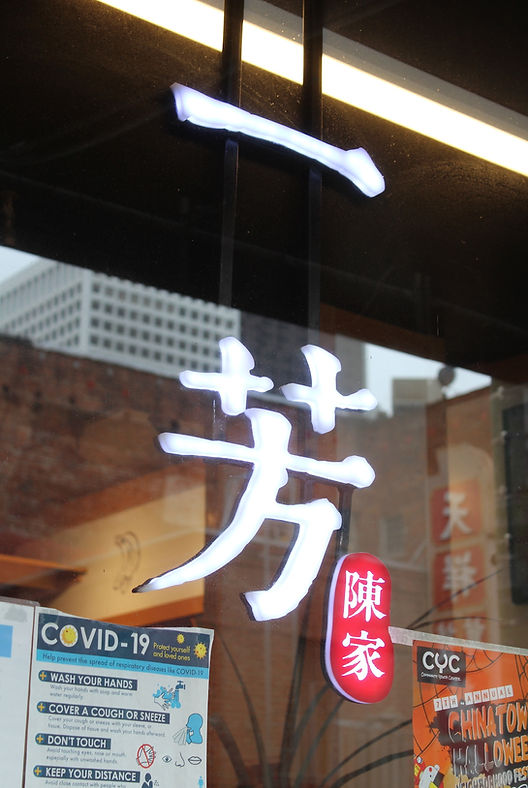
Afterwards, we got milk tea at Yifang, a tea shop I recognized as soon as I saw it. I looked over the menu, and saw so many things that reminded me of life on the island—Aiyu jelly, tapioca pearls, winter melon, grass jelly. When I walked in, I heard the staff speaking what I’d been listening for all day. Mandarin. Heck yeah, let’s go! I ordered in Chinese—a regular milk tea with boba, warm, 30% sugar. (“Zhōngbēi zhēnzhù nǎichá, wēnde, sān fen táng.”) The order rolled off my tongue like I visited a tea shop just yesterday, even though it’s been well over a year. The cashier seemed cheerfully surprised that I could speak Chinese. Any onlooker may have thought that I just did it for the attention, but after so long in the Anglophone world, I honestly just miss speaking Chinese.
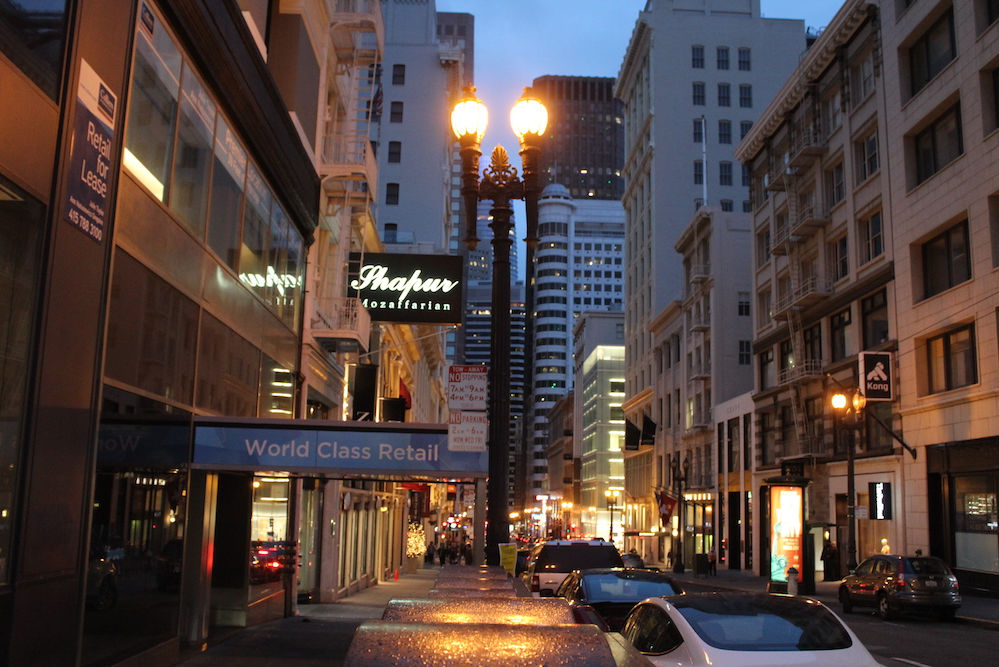
Our stomachs full and our wallets light, we passed through the rest of Chinatown at a leisurely walk. As soon as we left the crowded ethnic enclave, the rest of San Francisco felt empty, quiet, dead. We saw the port, the Martin Luther King, Jr. memorial, St. Patrick’s Church, and then Union Square all lit up at night. But Chinatown, in my opinion, remained the most exciting part of the city.
I hate to bring racism into it, but even just ten minutes of research into the history of American Chinatowns shows that they were effectively built as ghettos. Starting in the 1800’s, integration into American society was impossible for Chinese immigrants. And I don’t mean it was difficult, I mean it was legally impossible. Chinese people weren’t allowed to gain citizenship, testify in court, or own property. Chinatowns were conceived as a place for these disenfranchised people to exist. Over time, as harmful legislation was overthrown, Chinatowns slowly transformed into bustling cultural hubs, and now it’s hard to imagine big cities without such an ethnic district.
On the one hand, knowing all of this historical background sets me a little on edge going into a Chinatown. Spending a day on the town feels insensitive to the suffering that built the Chinatowns. But on the other hand, part of me feels like I grew up in Taiwan—I went there feeling like a kid and left feeling like a man—and while I’ll never be Taiwanese, being in Chinatown makes me feel a way I can only describe as “at home.” Chinatown is a place I don’t belong, but I feel like I do. And if I’m this emotionally messed-up about the whole thing, I can only imagine what the experience of people who live in Chinatown is like, watching your own countrymen walk through your neighborhood like tourists, like it’s somehow a place outside America.
Whenever visiting a Chinatown, I try to keep in mind that the space is a living community and not a fun fair established for the enjoyment of privileged folks looking to get cheap ethnic food and point at shop windows. And yet, it is a place where you can get cheap, good food, and the shop windows are full of things to point at. I guess most of your mental load goes into finding the balance between staring in awe and keeping a respectful distance. But even with the conflicting feelings, I’ll never stop visiting or loving Chinatowns. And San Francisco’s just might be the best one.


 zudlow
Leave a comment