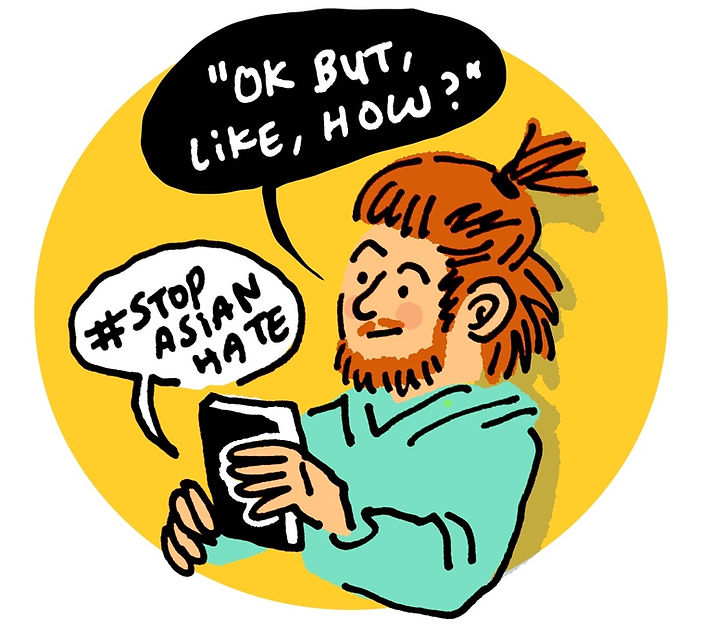
Every few weeks, a hashtag will rise out of the primordial haze to take over social media platforms. Last year we saw the country transform as #blacklivesmatter flags became as commonplace outside homes as the American flag used to be in the 50’s. Even if you weren’t actively fighting racism, it was fashionable to tack the hashtag onto your profile. Calling out performative activism became almost as time-consuming as calling out actual racism.
So it was no surprise when #stopasianhate became the racism-fighting hashtag of 2021, after reports of anti-AAPI (Asian American / Pacific Islander) incidents surged.
Anti-Asian sentiments have been present in America for years—decades. It could be calling your classmate’s lunch weird or making fun of Asian names. If crimes are not reported, they don’t go into the history books, and tragically, it may be that Asian attacks are merely being reported more accurately, rather than being on the rise. If you see a crime occur, by all means, report the incident and do your part in justice.
Unfortunately, when the #stopasianhate hashtag first appeared in March, it showed up in the captions of beautiful illustrations, or on hand-painted signs at protests. In my experience, the hashtag feels like a call to action, but without specifying what kind of action is needed.
White people have been told for years that their heritage and privilege are the causes of crimes against humanity. Whether or not this is true, it’s caused many of us to build up a layer of political scar tissue. So in the same way most decent people would agree that #blacklivesmatter, the hashgtag #stopasianhate evokes a lot of nodding, followed by a sense of inexplicable guilt, then searing indignity, and finally a magazine of defenses. “But I’m not a racist! What am I supposed to do?”
At first, I didn’t know how to respond to the #stopasianhate hashtag. I didn’t want to throw it into an illustration, like a pharisee doing alms before men, but I also didn’t want to turn a blind eye to the actual crimes that have been committed by nationalists and race supremacists.
Isn’t that enough? What’s the actual solution? In my opinion, practical steps are the best route forward. And I’m sure there are many people who can do a better job than me at writing such a list of steps, and I will probably get DM’d about how this post is just a giant tone-deaf virtue signal.
This guide is for normal people who aren’t actively instigating racial incidents, but who might want to cull out any passive racism left in their system. If you’re a violent racist, this article isn’t for you. (But therapy and a court date probably are.)
I believe the root of casual racism is misunderstanding of cultures. It’s easy to describe things you don’t understand or appreciate as “weird,” but that doesn’t help reach across the divide. So this isn’t a “List of Ways to Stop Racism,” but rather, a list of ways to promote understanding between the multitude of cultures that exist within American. It’s my hope that with this understanding, we can learn to live together more peacefully, to see each other not as others but as neighbors. So someday kids won’t get bullied for their lunch at school. This post is going to be MAJORLY lacking in critical race theory, so I apologize in advance.
(Again, if you’re looking for a list of community organizers or charities to donate to, you might want to check out another article.)
So here is my short list, from my tiny world, of little ways to help end Asian hate on the home front, for the everyday, working-class Joe or Jane. Some of them are going to be very specific; most of my experience has been with China/Taiwan, so you’ll find a heavy tilt in that direction. All of these suggestions come from my own experience, and if you have suggestions or your own experiences to recount, please leave them in a comment below! I would love to expand this post.

1. Consume Asian Media
The question, “Why do Americans consider Asian music weird?” can be answered easily. Because Americans are not exposed to it, and don’t understand it. Look up Tibetan Throat Singing. Watch some Beijing Opera. Listen to J-Pop. Watch K-Dramas. Enjoy some Bollywood. Every minute you consume Asian media is a minute you’re actively dismantling the mystery surrounding these cultures. Realize that the number of people who love these forms of media is greater than the number of people currently watching your favorite New York-based TV show.
My favorite K-Drama is Flowerboy Next Door. I can’t post a link, for legal reasons, but I’m sure you can find a way to watch it online. And take a peek at Beijing Opera—you probably won’t love it, but it’s always good to try something once.
2. Learn a second language
Mandarin, contrary to popular belief, is not the hardest language in the world. (I wrote a whole article about it.) Just spend a month learning some basic phrases, and if you like it it’s easy to build a small vocabulary. Learning Mandarin won’t end racism, but it will de-exoticize the language. Give it a shot!
Once you learn a second language, your brain restructures itself in a way that can feel traumatic. When you dismantle monolingualism, you become less judgmental. If nothing else, you’ll realize how hardworking immigrants learning English are.
It’s easy to start Mandarin with Duolingo. Of course there are a multitude of other languages you can sample. I only suggested Mandarin because that’s what I learned. Thai, Vietnamese, Hokkien, Japanese, Cambodian, and Tamil are a lot more niche than Mandarin and may be harder to find resources for, but find something you vibe with and go for it. (Also, it probably wouldn’t hurt to strip “Do you speak Asian?” from your vocabulary.)
3. Realize that offensive things are offensive
Sounds like a truism, but sometimes we do forget that x = x.
Gaslighting, in a single sentence, is telling someone that the feelings they’re having aren’t real. I can only imagine what it must be like to be a minority in America and have somebody tell me to just not be offended by a slur designed to dehumanize me. I sampled such a phenomenon in Taiwan—usually it was making fun of my sloppy Mandarin and telling me that was somehow good for my language skills—and let me tell you, while it did thicken my skin, it didn’t make me feel appreciated.
So if multiple people in an ethnic group are all telling you that a term or joke is offensive, realize that it’s not born of oversensitivity, it’s coming from a place of real hurt. See what terms you can stand to lose.
4. Visit Asia, but not as a tourist
Don’t spend all your time at a resort, because having locals serving you drinks by the pool just reinforces weird orientalist sentiments. Get out into the streets. Meet some people. Find out why they enjoy that food. Try to grasp their local raison d’être, and immerse yourself in the local culture as much as possible. In a short amount of time, you’ll start feeling like the weird one, and that feeling will stick with you. (Believe me.)
In Taiwan, even though I could speak conversational Mandarin, my red hair and big nose were like a flashing Vegas sign saying, “I’m different.” Sometimes people would turn to one of my friends and ask them questions about me in Taiwanese Hokkien, while I was standing right there. And take it from me, it feels terrible.
While I can’t imagine what it’s like to be a lifelong immigrant, four years in Taiwan did get me a slice of that cake. I also got to see what untraveled people looked like in other countries, and what that mindset looks like from the other side.
5. Don’t check up on Asian acquaintances
I know this one seems counterintuitive, but hear me out. If you are close with an Asian American or Pacific Islander, check in on them for sure. See if they feel safe, or if they’ve been in an incident, and if they’re OK. This kind of care makes sense in the context of a relationship. Ask yourself if you would communicate with them on a regular basis, were there not a fashionable hashtag in motion. If the answer is yes, definitely send them a message to see if they’re doing OK, especially if they live in a city. But probably don’t send a Facebook message to that one kid you knew in high school ten years ago. It’s just virtue signally, and literally doesn’t help at all.
In Conclusion
To summarize, get out of your head space, climb out of your box, and go get uncomfortable.
It does feel like I need to restate that these are all suggestions based on my experience, and they will not end racism. It takes years to dismantle discrimination, and those changes can’t be affected by posting a selfie with a hashtag. If you’ve gotten this far through my list of suggestions, chances are you’re a good person who cares about this issue. The best we can do is the best we can do. Of course, reach out to the people in your life who are most at-risk when it comes to racially-motivated violence. They can give you much better advice than me.
What are your thoughts on the subject? I’d love to hear them in the comment section below.



 zudlow
Leave a comment