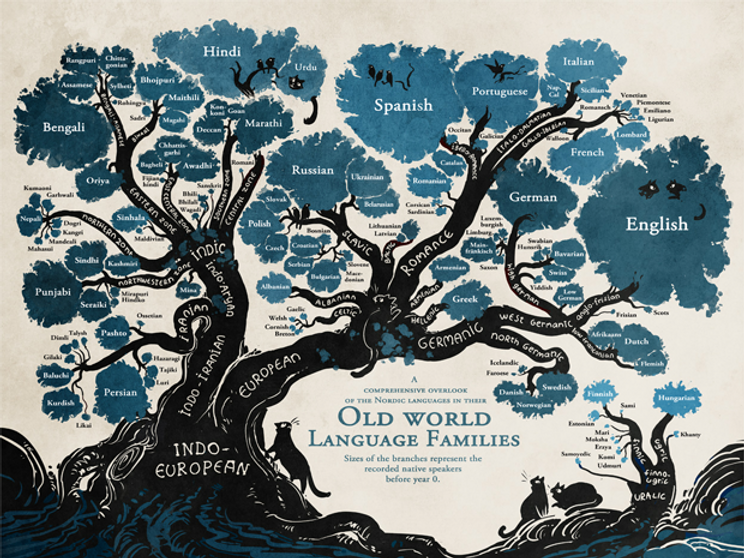
“One language is never enough.” -Unknown
Man, I feel this quote. I was born in America, and spoke only English for most of my life, and it never felt like quite enough.
When I was a kid, language was a foreign, magical thing. I believed that for everyone, the language you spoke sounded like English, and every other language sounded like Spanish. And when you learned a second language, it stopped sounding like Spanish and turned into English. I lived in this blissful naïvety until I found, one day while playing in the back of my church, a Gideon bibles with John 3:16 printed in multiple languages on the back few pages. My mind was blown. You mean to tell me, not only do languages sound different, but they look different, too?!
Thus started my lifelong quest to learn every language in the world.

Well, as I’ve gotten older, my life quest has been simplified, and at this point I’ll stave off at five languages (the number needed to make one a polyglot). But though my goal has shrunk, my fascination has stayed the same. I’ve flitted back and forth from language to language, which has made me a versatile learner. Because I’ve dabbled in so many languages and dialects, analysis and dissection of vocabulary and grammar is fairly easy at this point. (I’ve looked into almost every major language at least a little bit, and can read a number of scripts even if I don’t understand them.) However, it’s the speaking and comprehending of the languages that remains difficult for me.
Why is that? Because that’s the hard part.
So many people spend time learning how to read and write a language, they forget that speaking is perhaps the most important element. It’s also the hardest facet to master, because it requires going out of your comfort zone, humiliating yourself over and over, and doing mouth gymnastics you’ve never done before. Learning to speak doesn’t happen in the brain, it happens with your oral muscles. And to master that, you need to physically train for a certain amount of time before you’re able to perform well.
Think about that. Language is not just a mental exercise, but a muscle exercise. That’s why so many people give up before they’ve even reached the shores of potential. Imagine learning to ride a bicycle just from reading a book about it.
This hurdle is exactly why I remain bilingual. (English and Mandarin are the only languages I’m comfortable telling people I speak.) But as I’m approaching thirty years old, my goals weigh a little more heavily on my head than they have the past few years.
Is five languages by age thirty even possible, at this point?
How many language have I tried to learn, exactly? Here’s a breakdown, listed in roughly chronological order.
- Italian
- Spanish
- Tamil
- Russian
- American Sign Language
- Mandarin
- French
- Taiwanese Hokkien
- German
- Cantonese
In this post, I will review the languages I’ve tried to learn. Under each header, I’ll cover the following aspects:
- the degree of success with each language
- the difficult points
- the easiest aspects
- what lengths I’ve gone in order to master the language
Let’s begin! 開始吧!Давай начнем!

1. Italian
Growing up, Italian was the language of keeping secrets. When my Nonno and Nonna needed to plan a surprise in front of us, they would switch to Italian. They made trips to the Old Country every couple years, and we’d get news about the cousins. Italian had always been a foreign but familiar language, growing up. Finally, my parents got the Rosetta Stone on CD-ROM, and put an end to an age of mystery,
Italian is one of the easiest languages for English-speakers to learn, so I picked it up fast. However, I never progressed beyond level one. Do I regret this? Of course. I regret most missed opportunities in my life. If I kept it up, I would have been speaking Italian for twenty years by now. But I was a stubborn and lazy kid, and knowing myself I begged my parents to let me drop it, so, what am I gonna do.
*(I confirmed with my mom this morning that I did, in fact, beg them to let me drop it.)
Italian pronunciation is easy. Because most Americans grow up observing Italian immigrants, whether on film or in real life, we already instinctively know the rule for pronunciation—put the stress on the second-to-last syllable in a word. Once you’ve got this down, it’s easy to guess pronunciations.
Because of verb conjugation, usually pronouns are dropped. Unless you know the verb conjugations, it can be difficult to understand who’s being talked about. The good news is, conjugations are generally consistent.
When I was in France in 2016, I had the opportunity to fly to Rome for €25. I didn’t because I was chicken. But I plan to learn Italian and go to Italy sometime in the near future. In some ways, I feel like I’m already halfway there.

2. Spanish
Spanish is the first language I decided to actually learn on my own. My method was simple: I got a Spanish-English dictionary from the library, and started to hand-copy words that looked interesting. It was through this practice that my love for languages ignited, because it came from myself and it wasn’t assigned to me as homework. I started to do it for fun, and while my Spanish never took off, it was the first stepping stone.
The biggest downside to Spanish is that ultimately, I didn’t fall in love with it. I have no draw to Spanish-speaking countries, and for me travel and language are intertwined. While it gave me a base to understand romance languages later on, and acted as a mental exercise, Spanish is a language I don’t see myself going back to. Gracias por los recuerdos.
3. Tamil
While Spanish was my starter course in loving languages, Tamil upped my game. I could no longer guess vocabulary, spelling, pronunciation, or grammar anymore—I had to learn everything from scratch. I printed out my own course, which I downloaded from the internet. It looked something like this (https://www.learntamil.com). This foray into Tamil got me addicted to the dopamine that resulted from learning languages, and got me hooked on writing systems. (Writing Tamil is a lot of fun.) If you go through my journals at that time, you can see me starting to mix Tamil with English, eventually adding in Russian later. When eventually I pass away, they’re going to need teams of translators to decipher my journals, because it’s pretty messy.
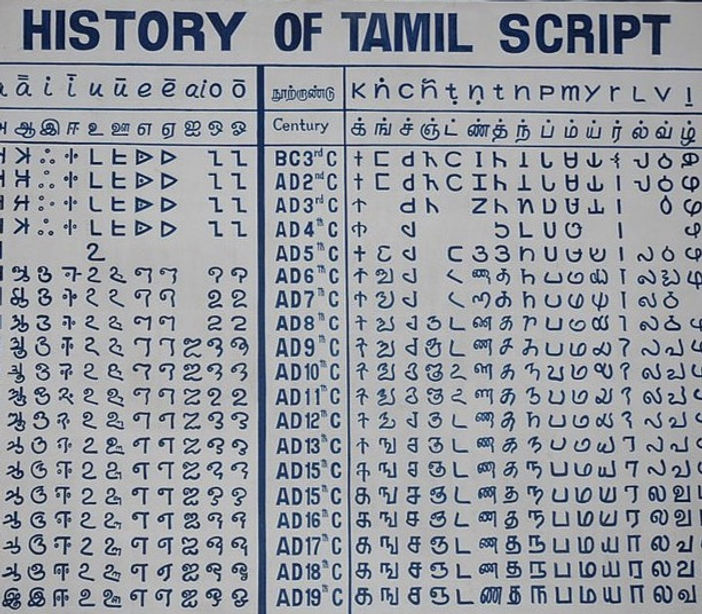
I learned English grammar from learning Tamil, actually. When I started, I didn’t know anything about noun cases, or even the actual rule behind “I vs. me.” Seeing grammar at work in a second language helped me realize things about my own language. Learning how to build a sentence in subject-object-verb format rearranged my brain and taught me that grammar is an illusion, which has served me well through all my language adventures.
Tamil’s difficult points…wow, where do I begin? First of all, a lack of native speakers. I’m from Maine, an extremely white state. Anybody up here who speaks Tamil would be a chore to find. It’s got some hard consonants to pronounce, and the grammar is agglutinative, meaning you stick particles together to form complicated verbs—one word can be an entire sentence.
In 2009, I went to India for a couple weeks. Unfortunately, I didn’t end up in any place where I would have needed Tamil. But on the way back home, I met a woman who’d spent six months in Vizag, and I thought, wow, six months, that’s a LONG time. (If only I knew that in seven years I would be spending four years in Taiwan.) It would have done me good to spend six months in Vizag learning Telugu, six months in France learning French, six months in Russia learning Russian. You can’t hardly do anything with less than that amount of time.
Given the high level of this language, combined with the rarity of speakers in my locale, I eventually lost the motivation to learn.

4. Russian
While Spanish was the first language I chose to learn, Russian was the first language that I really fell in love with, and was actually able to hold short conversations in. I got Rosetta Stone, put in the daily work, spoke it out loud, and mastered the Cyrillic alphabet.
I actually went to Ukraine in the 2010’s. It was my first solo trip. Getting to know the Ukrainian/Russian people, seeing the old soviet buildings, eating traditional food, riding old trains through forests and plains, and walking through Chekov’s rose garden, was all a dream come true. At one point, an old lady in a museum talked to me as though I were Russian. Maybe she knew that I was a tourist. But I like to believe I was just doing really, really good.

Since then, my Russian has grown shadowy. It remains in the back of my head, and sometimes it shifts to the front for a bit. I can still type Cyrillic pretty fast, and can sight read some words. While I can neither hold a casual conversation, nor read War & Peace, I still retained a bunch of words and this is actually pretty high on my “100% learn this language” list, which I’ll post at the end. Russian was my first love, and I very much see myself diving back into that language soon.
5. American Sign Language

I took sign language in community college just for fun, and got pretty good at it. But the more I learned about the deaf community, the more I got stuck in my head about it. Would they reject me? Obviously language-learning would be a primary practice the language, but would that be construed as using them? Would I be accused of exoticizing their culture? My professor emphasized the bias deaf people have against hearing people joining their community, and because of that, I ended up getting shy and calling the whole thing off. My brain put lots of it into storage, right next to Russian, but when I go on Deaf TikTok, it all comes back to me.
6. Mandarin

And now, finally, we get to Mandarin! The first language I actually “won” at:
- Fall in love with the language
- Learn to read and write it
- Speak it!
- Move to the country where the target language is spoken
I fell in love with Mandarin almost instantly. I took a year of it in university. In 2015, I visited China, and eventually I moved to Taiwan for four years. I truly immersed myself in it, and now I can watch Chinese movies and TV. shows, listen to Chinese music, and even read Chinese books. I’m probably 70% fluent in spoken Mandarin, and 50% in written (because there’s still a lot of characters I don’t know yet). A newspaper is definitely out, but I might be able to read a novel. Reading four books in Chinese is actually on my list of goals for this year.
To learn about the easy and difficult aspects of Mandarin, you can read my blog post, Is Mandarin The Hardest Language to Learn?
If someone wanted to learn a second language, I would 100% recommend Mandarin. If you can put aside the whole characters scene, it’s extremely easy to learn. There are 400 possible syllables, and five tones to remember. The tones are easy to learn, just like in English, but the characters are a whole ‘nother kettle of fish.

7. French
I’ve dipped in and out of French for years and years. I got within about five feet of jumping headlong into learning it, and that’s one of my top regrets in life, actually. In 2016, I lived in France for two months—one month in downtown Toulouse, on la Rive Gauche, right off Pont Saint-Michel, and one month out in the countryside of the Midi-Pyrenees. I loved being in France, but I didn’t immediately enroll in language classes, nor did I actively search for a way into the local community or social scene. If there’s a fish I beat myself over the head with daily, it’s this: That I didn’t spend an extra four months in France to learn French.
While I was there, though, I did manage to use French to order food, to navigate, to talk to bus drivers. Even now, I can read French and comprehend the gist, and pronunciation doesn’t scare me anymore.
It looks and sounds scary, but French is easy to pronounce, once you know the rules. Keep in mind—the last part of every word is essentially silent, unless it ends in a vowel, or the next word begins in a vowel. So for example, français is pronounced françai’, but the feminine version of the adjective, française, ends with an E, so you do pronounce that final S, française. (In Toulouse, we pronounced the E as well.)
This can also be counted a difficulty. Since there are so many “useless” letters, it can be hard to sort through it all. However, since I’ve hacked away at the language at least once every year for the past five years, I’ve slowly built a base knowledge of the vocab and grammar. Which leads me to a piece of advice: It’s OK to hack away at a language without fully committing. Because it will be easier and easier every time you come back to it, and the neurons strengthen with time. The worst thing to do is to never start something because you’re afraid of giving up later.

8. Taiwanese Hokkien
During my tenure in Taiwan, I learned something I wasn’t planning on learning: Taiwanese Hokkien. At first when I heard it I thought it was Mandarin with an accent, but the longer I lived there the more I realized, these are two VERY different languages.
It’s very nasally, and sounds more like Cantonese than Mandarin. Though it shares some vocabulary with Mandarin, the two languages are mutually unintelligible.
You can hear Hokkien yelled in markets, or used between family members at home. It’s also used ceremonially, at funerals, some commencement ceremonies, or even weddings. I’ve found the usage of Taiwanese Hokkien extremely nuanced. Sometimes it’s used to add flavor, sometimes it’s used to sound more familiar with someone, and sometimes it’s written in signs to make a shop seem more local.
What frustrated me the most about Taiwanese Hokkien was that no matter how hard I tried, my pronunciation was never seen as “good enough” to be understood. Another thing that happened quite often was that sometimes I would meet a new person, and they would turn to one of my Taiwanese friends and start asking questions about me, in Taiwanese Hokkien, while I was standing right there. (This is what led me to believe that in the international scene in Taipei, Hokkien is often used as an unintentional exclusion code.) Because of these negative experiences with Taiwanese Hokkien, I never immersed myself in learning it.
Another hurdle is that Taiwanese is mainly a spoken language. Its written component is very sloppy and hard to read, and many of the Taiwanese don’t even know how to write it. Because of this, and its lack of presence on the world stage, it’s hard to find resources for learning it. If I had another shot at it, I would definitely enroll in a class to learn it, because objectively it’s a beautiful language.
9. German
While living in Taiwan, my friend decided to learn German. Realizing I could support him while at the same time expanding my own brain, we took some German classes together for about a year.
Overall? Grammar clobbered me. With verbs moving all over sentences, nouns changing case, and three separate word genders to memorize, I found myself overthinking every sentence.
If you come from English, phoneme pronunciation is relatively easy. Many nouns in German are cognates with English, meaning there are some vocabulary shortcuts. However, the nitpickiness of the language made this a rather ruthless addition to my language list.
As far as travel goes, I’ve never gotten further than the Dusseldorf airport. In a pinch, I’d probably be able to fake my way through Berlin for a day. But in the end, this will probably be a language I come back to infrequently, over and over again, for the rest of my life.
We’ll see.
10. Cantonese
The sudden urge to learn Cantonese hit me at 11:00 one night while I lay in bed watching YouTube videos. I’ve been picking at it irregularly for a couple months, and the decision is partly functional; because I can already speak Mandarin. There are six tones, which I haven’t tried tackling yet. I’m currently learning this language with a listen-and-repeat method I’m trying out. I watch youtube videos, make notes, and look up pronunciations on Forvo when necessary. Trying to stay away from grammar with this one.
For a language with 70 mil+ speakers, resources are surprisingly difficult to find.
I went to Hong Kong in 2019, and made the foolish mistake of trying to speak Mandarin to people. They didn’t like that. If I had done a little research, I would have learned that Cantonese and English are both equally viable options for Hong Kong.
CONCLUSION
Every time I write this list, I realize just how far I actually got in each language. And I realize that if I put in a year of study for each language, I’d speak 11 languages by 2029. (Wow.)
Most of us study for a month and wonder why we’re not fluent yet. But language acquisition takes time. It takes months, if not years, for a language to click. And what can we do in the meantime? We can study, we can work hard. We can practice speaking with and listening to with native speakers. The hard footwork, while you’re getting it going, is not rewarding.
There is a point where it starts to build up its own momentum, and the feeling is much like when you’re cutting wrapping paper and your scissors start gliding. But before you get to that point, it’s frustrating. It’s borrowing energy from today to cash in tomorrow. And there are very few people in the world who are willing to put in that effort without seeing some kind of a return.
MUST-LEARN LANGUAGES BEFORE 31
In conclusion, the languages I plan to “finish” learning by age thirty are the following.
- Cantonese
- Italian
- French
- Russian
I put finish in quotes because you never actually finish a language. As a millennial I’m trying to keep on top of our changing English language, and to be honest I think I’m doing a pretty good job. (My diction is gen-z approved.) But there are times I have no idea what zoomers are saying. I haven’t even learned all of English yet.
What’s “good enough” look like for me? I think if I’m able to connect with people in my target language, without using English, and be able to establish friendships where language exchange isn’t the primary motivation, that will tell me I’ve made it.
Given six months for each language, I think five languages before I’m 31 is entirely doable. The trick, as always, is just doing it.
If one language is never enough, then how many is enough?
I’ll let you know when I find out.


 zudlow
Leave a comment